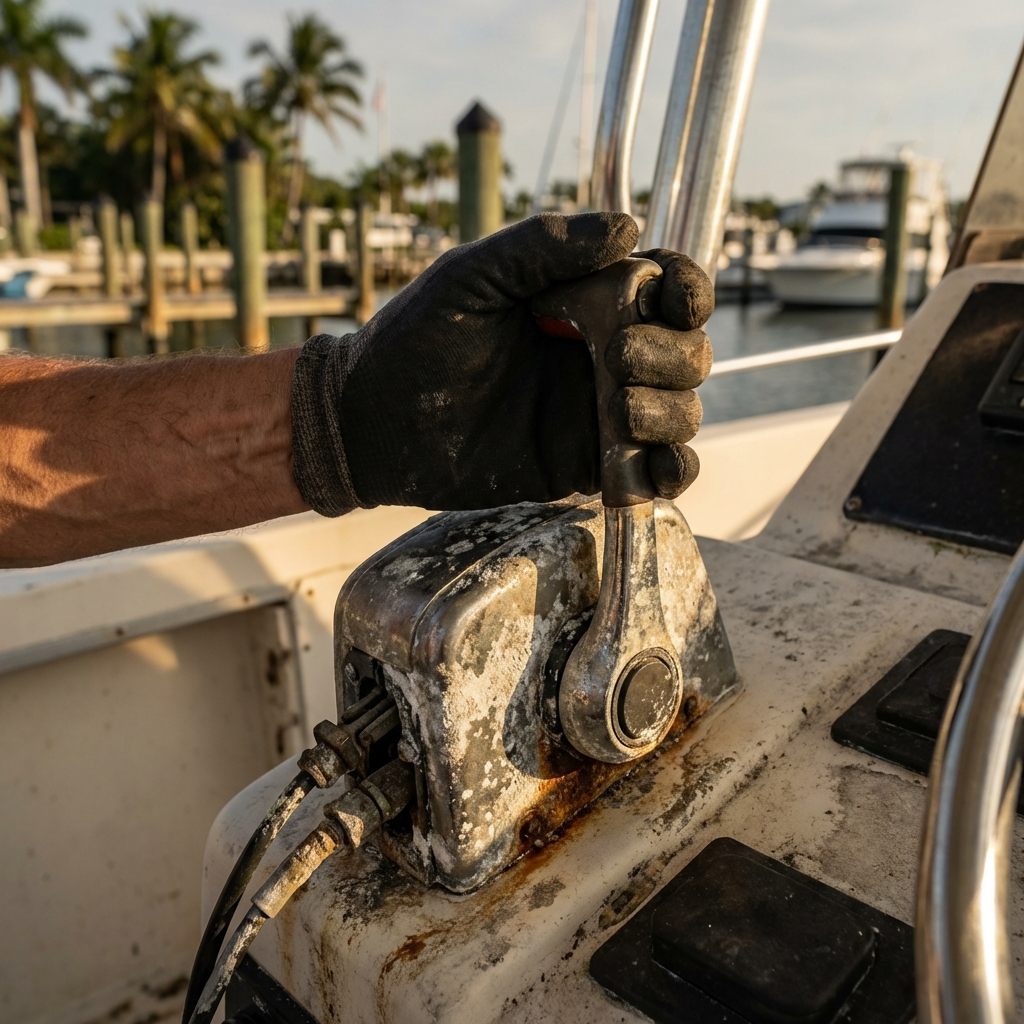
Why Your Boat Throttle or Shift Feels Stiff (And What It Means)
Why Your Throttle or Shift Feels Stiff (And What It Means)
A throttle or shift control that suddenly feels stiff is more than an annoyance. On an outboard-powered boat, control friction can affect smooth docking, safe acceleration, and predictable shifting. In Florida saltwater conditions, stiffness is often caused by corrosion, dried lubrication, worn components, or cable problems that develop gradually until the helm feels noticeably heavy.
This article explains common reasons a boat throttle or shift may feel stiff, what you can observe safely, and why addressing the root cause matters for reliability and control. The goal is not to teach complex repairs, but to help you recognize symptoms early and communicate clearly with a marine technician.
What stiff controls usually indicate
Most boats with Yamaha outboards use mechanical control cables that transmit your throttle and shift inputs from the control box to the engine. When something adds friction or resistance anywhere along that path, the handle can feel heavy, notchy, or inconsistent. Sometimes the stiffness is only in one direction (for example, harder to shift into forward than reverse), which can point to specific wear patterns or binding.
Because the control system is shared between throttle and shift functions, it helps to pay attention to exactly what feels stiff and when it happens:
- Stiff throttle: the lever is hard to move through the RPM range, may feel sticky at certain positions, or may not return smoothly.
- Stiff shifting: moving into forward or reverse requires extra force, may grind or clunk more than usual, or feels like it hangs before engaging.
- Both stiff: often suggests a cable routing/binding issue, severe corrosion, a failing control box mechanism, or multiple aging components.
Common causes of stiff throttle or shift
1) Aging or corroded control cables
Control cables live a tough life: heat, humidity, salt exposure, and constant bending. Inside the cable jacket, the inner core slides back and forth. Over time, corrosion or contamination can increase friction, and the core can begin to bind. A cable may also develop internal damage from tight bends or chafe points, which can create stiffness that comes and goes as the engine steers or trims.
Signs that point toward cable issues include stiffness that changes when you turn the wheel, stiffness that is worse after rain or washing, and a lever feel that is consistently heavy across the whole range of motion.
2) Poor cable routing or tight bends
Even a healthy cable can feel stiff if it is routed with sharp bends, compressed under a rigging hose, or pinched by clamps or tie-wraps. This is common after accessory installs, repowers, or rigging changes where the cable path is altered. When the engine turns from lock to lock, the bend radius changes, and friction can increase dramatically.
Because steering movement can change the feel, you may notice the control is easier at center and harder with the engine turned. That clue helps a technician focus on routing and rigging tube layout.
3) Stiff or contaminated control box mechanism
The control box itself contains moving parts, detents, bushings, and friction components that can wear or collect debris. In coastal environments, salt air can contribute to corrosion inside the control housing, especially if water intrusion occurs. A worn detent mechanism can create a notchy feel, while corrosion can create a uniformly heavy lever.
Control boxes are safety-critical components. Inspection and internal service should be handled by a qualified marine technician to ensure correct operation of neutral interlocks and shift/throttle synchronization.
4) Binding at the engine connection points
At the engine, cables connect to throttle and shift linkages. These linkages include pivots and moving joints that need to move freely. If they become dirty, dry, or corroded, you can feel added resistance at the helm. In some cases, the resistance is more noticeable at specific points, such as when advancing from idle or when shifting off neutral.
Because engine linkages interact with the throttle cam, idle control, and shift components, it is important not to force stiff controls. Forcing can accelerate wear or mask a developing issue that should be corrected.
5) Improper adjustment or misalignment
If cable adjustments are off, the system can preload the linkage, causing unnecessary friction. Misadjustment can also affect shift timing, which may make engagement feel harsher. Adjustment is not just about lever feel; it is about ensuring the engine reaches full throttle and correct shift travel without over-travel or binding.
Adjustment should be verified to manufacturer specifications. Incorrect settings can contribute to clutch dog wear in the lower unit over time, so it is worth addressing early.
6) Environmental factors: salt, sand, and storage conditions
Boats stored near the beach or used in shallow, sandy areas often accumulate fine grit that can work its way into rigging areas. High heat can also accelerate drying of lubricants and aging of plastic liners. If stiffness is seasonal (worse after long storage or after a particularly wet period), environmental exposure may be a contributing factor.
Why you should not ignore stiff controls
Stiff throttle or shift can increase the chance of over-correcting during docking or close-quarters maneuvering. It can also lead to jerky throttle application, delayed shifting, or extra force that stresses cables and control components. In the worst cases, a cable can bind enough to affect your ability to reduce power quickly.
If the control suddenly becomes significantly harder to move, feels like it is catching, or does not return smoothly, treat it as a reliability concern. Avoid forcing the lever and consider having the boat inspected before the next outing.
Safe observations you can make before calling for service
You can gather useful information without disassembling critical components. The goal is to note patterns and conditions, not to perform risky repairs.
Document when the stiffness happens
- Is the stiffness in throttle, shift, or both?
- Is it worse when the engine is turned to one side?
- Does it change with trim angle?
- Did it start after an installation (new electronics, battery work, rigging changes)?
- Is it worse after washing, heavy rain, or sitting unused?
Look for obvious rigging stress (visual only)
With the boat secured and the engine off, you can visually inspect the rigging path at the transom and under the console (if accessible) for obvious problems such as kinks, crushed sections, or rubbing points. Do not spray unknown lubricants into control boxes or cable ends, and do not disconnect cables unless you are trained to reassemble and verify safe operation.
Pay attention to shifting behavior
Noting whether shifting is stiff going into forward, reverse, or both can help narrow the issue. Also note whether engagement feels delayed or harsher than normal. Any new grinding noises, difficulty finding neutral, or alarms should be treated as reasons to stop troubleshooting and schedule professional inspection.
Preventive habits that help reduce control stiffness
While some wear is inevitable, consistent care helps reduce corrosion and catches issues earlier. These habits are generally safe and helpful for most boat owners.
Rinse and dry rigging areas
After saltwater use, rinsing the exterior rigging area and allowing time to dry can reduce salt buildup. Avoid directing high-pressure water into control boxes, wiring openings, or cable ends, as forced water intrusion can create corrosion inside housings.
Use scheduled maintenance to check control feel
During routine service, a technician can evaluate control friction, verify cable routing and adjustment, and inspect engine-side linkage movement. Catching increased resistance early can prevent a progressive bind and reduce the likelihood of needing multiple parts at once.
Protect the boat during storage
Ventilation, reducing standing water in bilge and compartments, and keeping covers properly fitted can help limit moisture exposure. In humid coastal climates, small improvements in airflow and dryness can slow corrosion in control systems and connectors.
When to stop and call a Yamaha outboard technician
Some symptoms suggest the boat should be inspected before further use because control reliability is directly tied to safety and maneuverability. Consider scheduling service if you notice any of the following:
- A sudden change from normal to very stiff or sticky control movement
- Throttle that does not return smoothly or feels like it is hanging up
- Difficulty engaging forward or reverse, or trouble finding neutral
- Stiffness that changes drastically with steering angle (possible cable bind)
- Visible cable damage, severe corrosion, or rigging that appears pinched
A Yamaha Outboard Master Certified Technician can isolate whether the resistance is coming from the control box, the cable run, or the engine-side linkage, and then correct the cause using manufacturer-appropriate parts and adjustment procedures.
If your throttle or shift feels stiff and you would like a professional evaluation in Brevard County, Florida, schedule a diagnostic inspection with Steven Naeder at Yamaha Outboard Specialist. Contact Yamaha Outboard Specialist


